

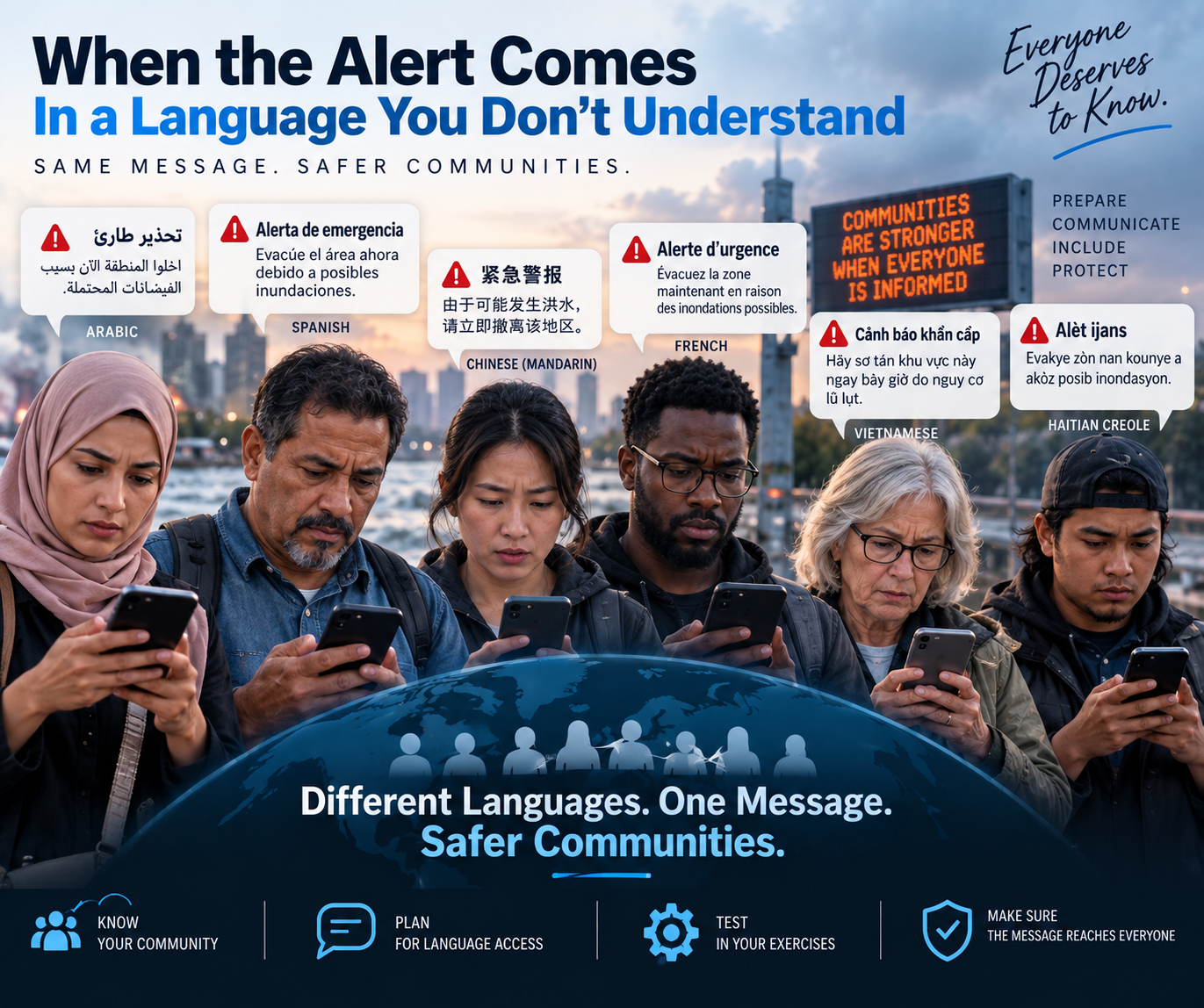

Your phone buzzes.
Emergency Alert.
There is a wildfire nearby. A flash flood is coming. A chemical release has occurred. You need to evacuate.
Now imagine that message is written in a language you cannot read.
In that moment, an alert was technically sent, but was the warning actually communicated?
That distinction matters.
Sending an Alert is Not the Same as Reaching a Community
Mobile emergency alerts have become an important part of how we warn the public. They can reach thousands or even millions of people quickly, including people who may not be watching television, listening to the radio, or following local emergency management agencies online.
But speed alone does not make risk communication effective.
A warning has to be received, understood, trusted, and actionable.
Language can become a major barrier at every one of those steps.
If a community includes people who primarily speak Arabic, Spanish, Mandarin, Korean, Haitian Creole, Vietnamese, or another language, an English-only alert may leave some residents trying to figure out what is happening while everyone else is already acting.
During a disaster, those minutes matter.
“Evacuate Now” Should Not Require Translation
Think about what we expect someone to understand from an emergency alert:
Where is the danger?
Who is affected?
Do I need to evacuate or shelter in place?
Where should I go?
What should I bring?
Is the water safe?
Which roads are closed?
Where can I get more information?
Those are not minor details. They can determine what someone does next.
We cannot assume that people will have time to copy a message into a translation app, find an English-speaking family member, search social media, or wait for someone else to explain it.
And automated translation should not be the first time an organization discovers whether its emergency terminology translates clearly.
Language Access is a Preparedness Issue
This is why language access needs to be considered before the emergency.
Emergency managers and health care organizations should know which languages are spoken in the communities they serve. Common emergency instructions can be translated and reviewed ahead of time. Organizations can identify qualified interpreters and trusted community partners before they are desperately searching for them during an incident.
Exercises should test this too.
During the next tabletop, don’t just say:
“A mobile alert is sent to the community.”
Ask:
In what languages?
Then keep going.
Who translates it? Who approves the translation? How long does that take? Can the technology actually distribute multilingual messages? Are translated messages released at the same time as the English message? What happens when there isn’t a prepared translation for an unexpected hazard?
That is where an exercise starts revealing actual gaps.
Translation is Only Part of the Answer
There is another important piece to this conversation.
Language access is not the same as simply translating words.
Messages have to make sense to the people receiving them.
Terminology that is familiar to emergency managers may mean nothing to the public. Even something as common to us as “shelter in place” may require clearer instructions about what someone should actually do.
Culture, literacy, trust, disability, access to technology, and familiarity with emergency systems all influence how a warning is received.
That is why community organizations, faith communities, schools, health care organizations, interpreters, and other trusted messengers should be part of preparedness, not added after something goes wrong.
Communication is an Intervention
I say this often because I believe it:
Communication during a disaster is an intervention.
We would never be satisfied knowing that a medication reached only the patients who could read its instructions.
We shouldn’t be satisfied with an emergency warning that reaches a phone but not the person holding it.
An alert isn’t successful because we can document that it was sent.
It is successful when the person receiving it understands:
This affects me.
This is what I need to do.
This is where I need to go.
And I need to act now.
As our communities become increasingly diverse, multilingual emergency communication cannot be an afterthought.
It needs to be part of planning.
Part of exercises.
Part of our communication systems.
And part of how we define preparedness.
Because when seconds matter, everyone deserves to understand the warning.