

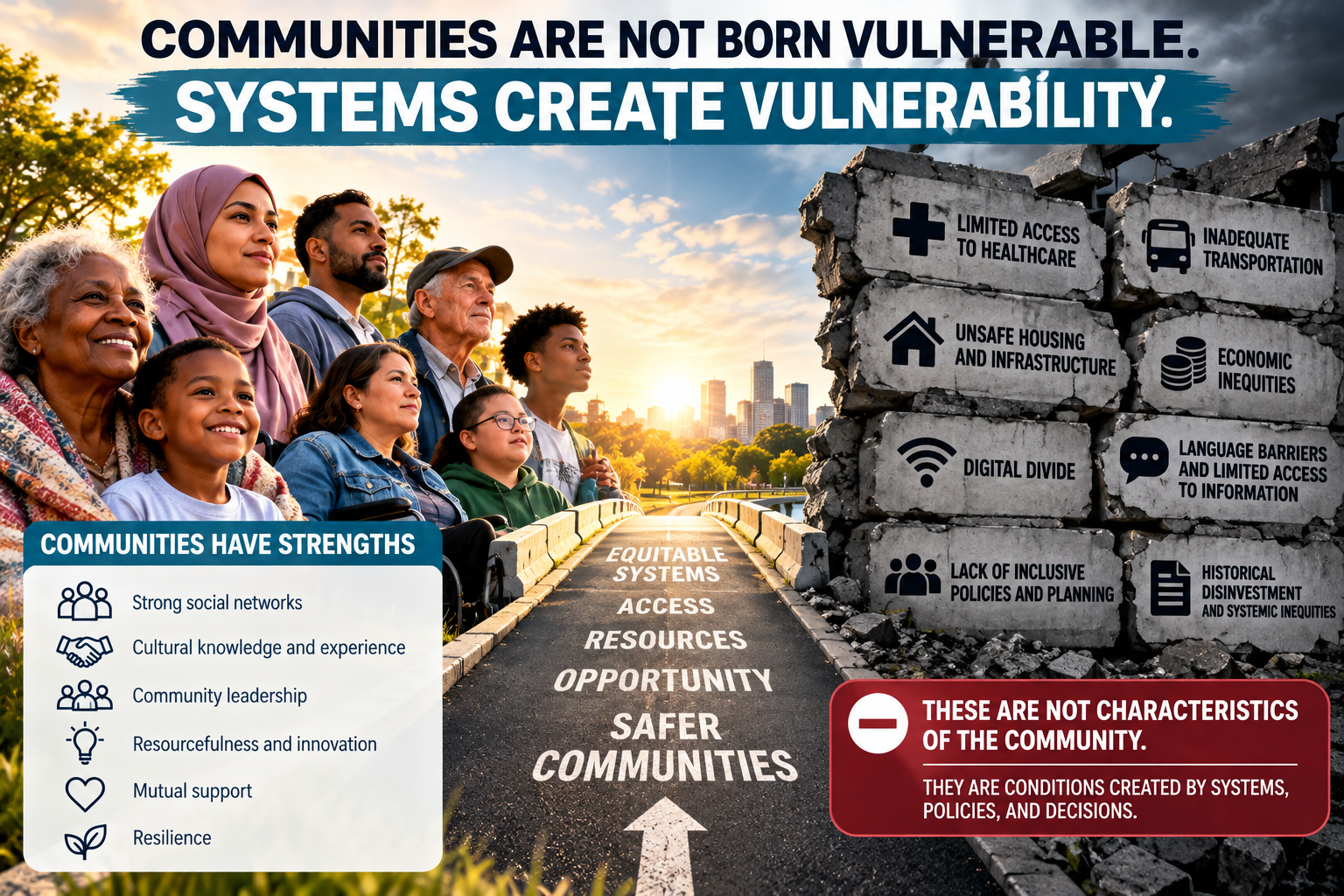

I want us to reconsider a phrase we use far too often in healthcare, public health, and disaster preparedness.
Vulnerable communities.
We see it in research articles, grant applications, emergency preparedness plans, public health reports, and policy discussions.
We use it to describe communities experiencing poverty, older adults, people with disabilities, refugees, displaced populations, rural residents, and individuals with limited access to healthcare.
We use the phrase so frequently that we rarely stop to question what we are actually saying.
But I have a problem with it.
Communities are not inherently vulnerable. They are often made vulnerable by the systems, policies, and circumstances that surround them.
And that distinction matters.
Vulnerability Is Not an Identity
When we describe an entire community as vulnerable, we risk suggesting that vulnerability is an inherent characteristic of the people living there.
As though poverty, disability, geographic isolation, or displacement automatically defines someone’s ability to prepare for, respond to, or recover from an emergency.
But that is not how vulnerability works.
A community may have extraordinary social networks, strong leadership, cultural knowledge, and generations of experience navigating adversity.
Its residents may understand their environment better than any outside emergency management agency.
They may have informal systems of communication, resource sharing, and mutual support that have sustained them long before an organization arrived with a preparedness plan.
Yet we label them vulnerable.
Why?
Because they lack resources?
Because their infrastructure is inadequate?
Because they have limited access to transportation, healthcare, or emergency services?
Those are not necessarily failures of the community.
They are often failures of the systems intended to serve it.
We need to stop confusing a lack of resources with a lack of resilience.
Disasters Do Not Affect Everyone Equally
Throughout my career in emergency nursing, public health, and disaster response, I have seen how the consequences of emergencies are shaped by circumstances that existed long before the disaster occurred.
A hurricane does not create poverty.
A flood does not create inadequate housing.
A wildfire does not create barriers to healthcare.
And an infectious disease outbreak does not suddenly create the inequities that have existed within healthcare systems for decades.
These events expose and frequently magnify existing conditions.
Consider two families living in the same community when an evacuation order is issued.
One family has reliable transportation, financial resources, paid leave, access to information, and relatives who can provide temporary housing.
The other family relies on public transportation, lives paycheck to paycheck, cares for an older adult who requires electricity-dependent medical equipment, and cannot afford to miss work.
Both families face the same hazard.
But they do not have the same ability to respond.
Is the second family inherently vulnerable?
Or have economic, infrastructural, and institutional conditions created barriers that make it more difficult for them to protect themselves?
That is the question we should be asking.
We Cannot Keep Asking Communities to Be Resilient While Ignoring the Conditions That Put Them at Risk
Resilience has become another frequently used term in disaster preparedness.
We talk about building resilient communities, strengthening resilience, and helping people bounce back after disasters.
But I think we need to be careful about what we are asking people to bounce back to.
If a community lacked access to healthcare before a disaster, returning to that same condition is not necessarily recovery.
If residents lived in unsafe housing before a flood, rebuilding those same structures without addressing the underlying risks does not represent meaningful progress.
If an older adult could not access transportation before an emergency, restoring the same inaccessible transportation system does not eliminate the barrier.
And if a rural hospital was struggling to maintain staffing and essential services before a disaster, returning it to those same operational limitations does not make the community safer.
Resilience should not mean expecting people to repeatedly survive conditions that we have the ability and responsibility to improve.
There is a difference between celebrating a community’s strength and using that strength to justify inaction.
Communities should not have to demonstrate extraordinary resilience simply to receive equitable access to basic resources.
The Problem With Our Preparedness Plans
One of my greatest concerns in disaster preparedness is the tendency to identify certain populations as vulnerable without meaningfully addressing the conditions that create their increased risk.
We create lists.
Older adult