


I teach disaster preparedness, response, and disaster nursing, and there is one phrase I think we need to stop using:
Natural disaster.
Earthquakes are natural. Hurricanes are natural. Floods, volcanic eruptions, and severe storms are natural hazards.
But the disaster that follows is not simply an act of nature.
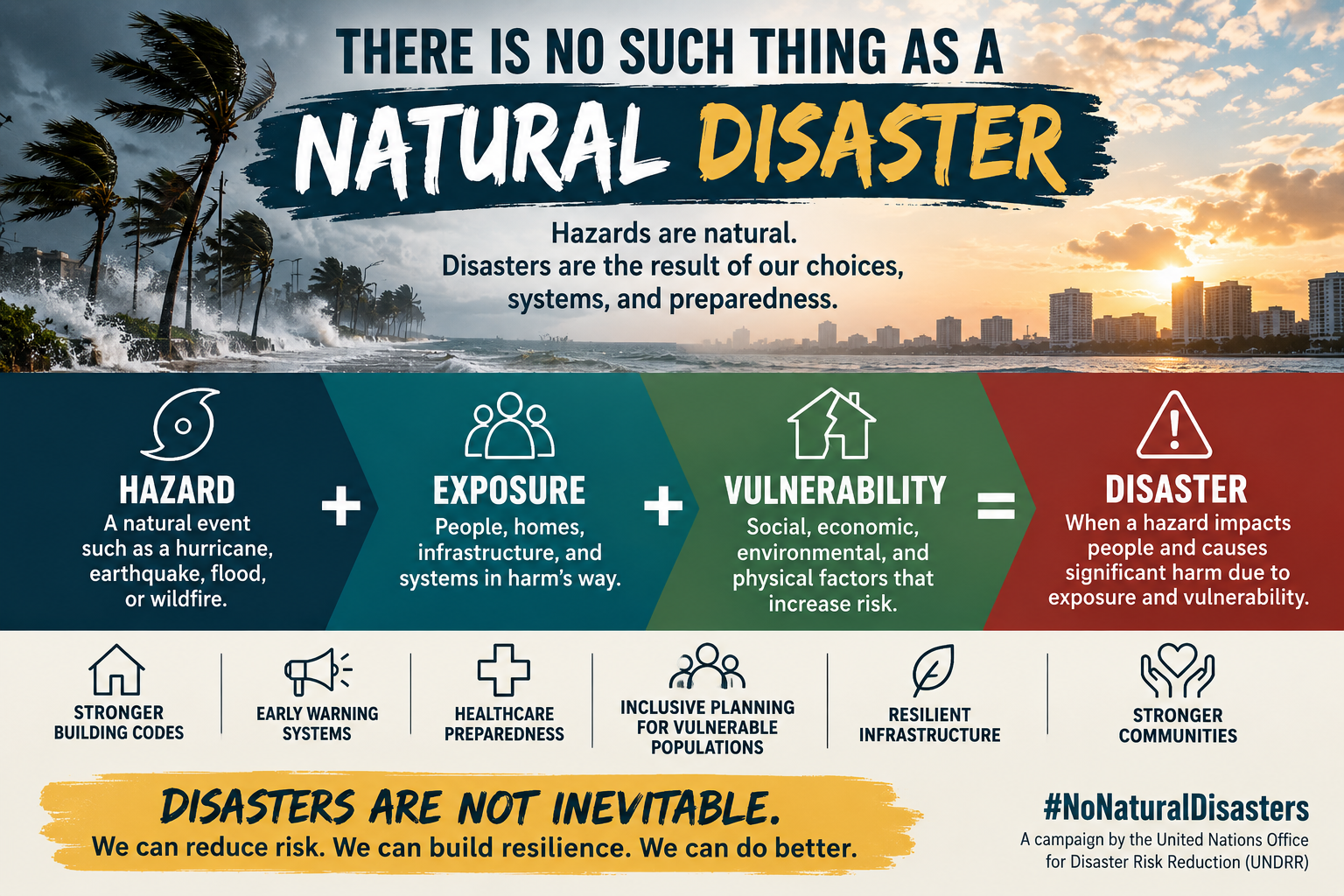
The United Nations Office for Disaster Risk Reduction (UNDRR) has an important campaign called #NoNaturalDisasters, built around a simple concept:
Disaster = hazard + exposure + vulnerability. (UNDRR)
That distinction matters.
Two communities can experience the same type of hazard and have completely different outcomes. Why?
Because what happens before the hazard matters.
Building codes matter.
Early warning systems matter.
Healthcare infrastructure matters.
Emergency planning matters.
Transportation matters.
Communication matters.
Poverty matters.
Disability access matters.
Where people live matters.
Whether people trust the warnings they receive matters.
And whether our plans actually account for the people most likely to be harmed matters.
A hurricane does not decide which hospital has a functioning generator.
An earthquake does not decide whether buildings were constructed to withstand shaking.
A flood does not decide whether a community built homes in a floodplain without adequate mitigation.
The hazard may be natural. The conditions that allow that hazard to become catastrophic are often created, or left unaddressed, by people and systems.
Why Language Matters
Calling something a “natural disaster” can subtly suggest that the destruction was inevitable.
It wasn’t necessarily inevitable.
UNDRR points out that we can reduce disaster risk through early warning, preparedness, protection of vulnerable populations, resilient infrastructure, and investment in resilience. (UNDRR)
That changes the conversation from:
“What happened?”
to:
“Why did this hazard cause so much harm, and what could we have done differently?”
That second question is where disaster risk reduction begins.
This is Also a Healthcare Issue
For healthcare professionals, this distinction is especially important.
When a hospital loses power during a storm, when medications cannot reach a community after flooding, when people with disabilities cannot evacuate, when older adults are isolated during extreme heat, or when healthcare workers arrive without the equipment, information, or training they need, those consequences cannot always be attributed to the hazard alone.
We have to examine the systems surrounding it.
Were we prepared?
Did we identify who was most vulnerable?
Were resources available, and were they actually accessible?
Did people know how to use them?
Were our plans realistic?
Did we practice them?
Did our warnings reach people in a language and format they could understand?
Those are human decisions.
Preparedness is Prevention
We cannot prevent every hurricane.
We cannot prevent every earthquake.
We cannot stop every flood, wildfire, or extreme weather event.
But we can influence whether those hazards become disasters.
That is why disaster preparedness cannot begin when the sirens sound.
It begins years earlier, with education, mitigation, resilient infrastructure, strong public health systems, community partnerships, risk communication, training, exercises, and policies that recognize vulnerability before an emergency exposes it.
And this is why disaster professionals must continue moving beyond simply responding to disasters.
Our responsibility is also to understand and reduce the conditions that create them.
The next time you hear the phrase “natural disaster,” consider replacing it with “natural hazard” or describing the actual event: earthquake, hurricane, flood, wildfire, tsunami.
It may seem like a small change in language.
It isn’t.
Because when we recognize that disasters are not inevitable, we also recognize something much more important:
We have the ability, and the responsibility, to reduce their impact.
#NoNaturalDisasters #DisasterPreparedness #DisasterRiskReduction #DisasterNursing #EmergencyPreparedness #PublicHealth #Resilience #NursingLeadership