


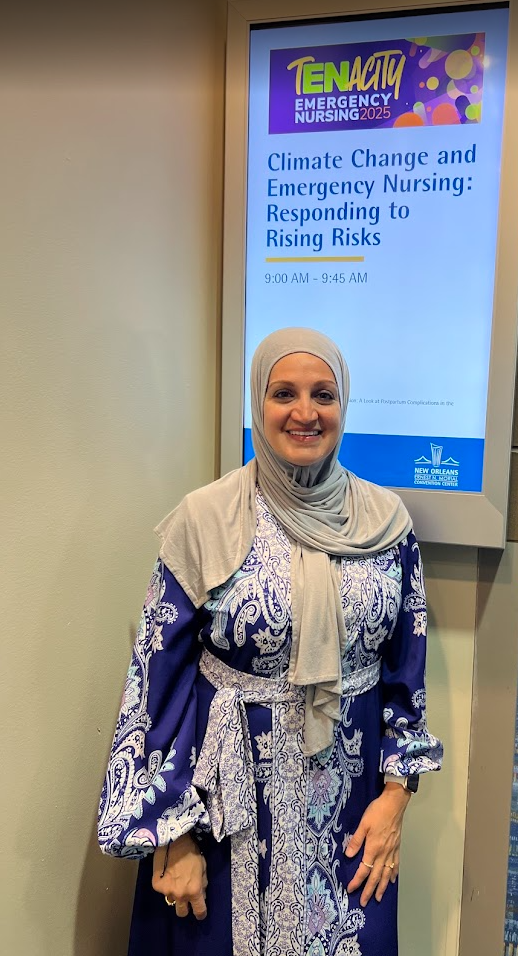
Standing in front of the sign at ENA 2025 in New Orleans a few weeks ago, I was filled with pride and responsibility as I prepared to present on Climate Change and Emergency Nursing: Responding to Rising Risks. But this presentation was not mine alone-it was a collaborative effort with a fellow nurse colleague in Baghdad, Iraq. Together, we brought two perspectives: one from the U.S., and one from a region where conflict and climate risks often collide.
This collaboration reminded me of a powerful truth: we cannot afford to work in silos. Nurses everywhere are facing the rising tide of climate-driven disasters, and our voices are stronger when amplified together.
🌍 The Urgency of Now
Our joint presentation highlighted how climate change is intensifying disasters across the globe, disrupting health systems, and creating ripple effects in communities already strained by conflict, displacement, and economic hardship.
Recent headlines show this reality all too clearly:
- Philippines Earthquake & Cascading Risks: Hospitals in Cebu were overwhelmed after a 6.9 quake, with landslides and floods compounding the devastation-an example of cascading risks that nurses on the ground must respond to.
- Wildfires Becoming Unstoppable: From California to the Mediterranean, deadly wildfires are increasing in number and intensity, fueled by drought, high winds, and heat. These events strain emergency departments and threaten both responders and communities.
- Pakistan’s Monsoon Floods: Intensified by climate change, catastrophic flooding submerged entire regions, cutting off patients from care, disrupting supply chains, and raising waterborne disease risks.
- Himalayan Chain Disasters: In India, extreme rains have triggered “disasters within disasters”-cloudbursts leading to landslides, floods, and mass casualties-requiring rapid, coordinated emergency responses.
These are not isolated events. They are interconnected global crises.
👩⚕️ The Power of Nursing Collaboration
Emergency nurses everywhere-whether in New Orleans, Baghdad, or beyond-are seeing these risks firsthand. We treat the heatstroke patients, the smoke-inhalation victims, the children displaced by floods.
By collaborating across borders, we amplify each other’s voices and share strategies that save lives. My co-presenter in Baghdad spoke about how extreme heat, dust storms, and disrupted health infrastructure are compounding patient risks in Iraq. By pairing her lived experience with my U.S. perspective, we underscored a simple but vital point: no single nurse, hospital, or nation has all the answers. We need each other.
✨ A Call to Action
This presentation was more than a session-it was a global conversation. It showed the power of partnership and the importance of making sure nurses everywhere have a platform to be heard.
Climate change is reshaping the health landscape, and nurses are on the frontlines. Together, by connecting across borders, disciplines, and experiences, we can create more resilient systems, advocate for equitable policies, and ensure that the most vulnerable are not left behind.
Let’s commit to amplifying each other’s voices, not just in conference rooms, but in every space where decisions about health, climate, and disaster response are being made.
👉 Who are you collaborating with? If you’re a nurse, educator, or researcher, I challenge you to step outside your silo-connect with colleagues across the globe, share what you’re learning, and be part of this collective movement. Our future depends on it.
#adventureswithnursejamla