

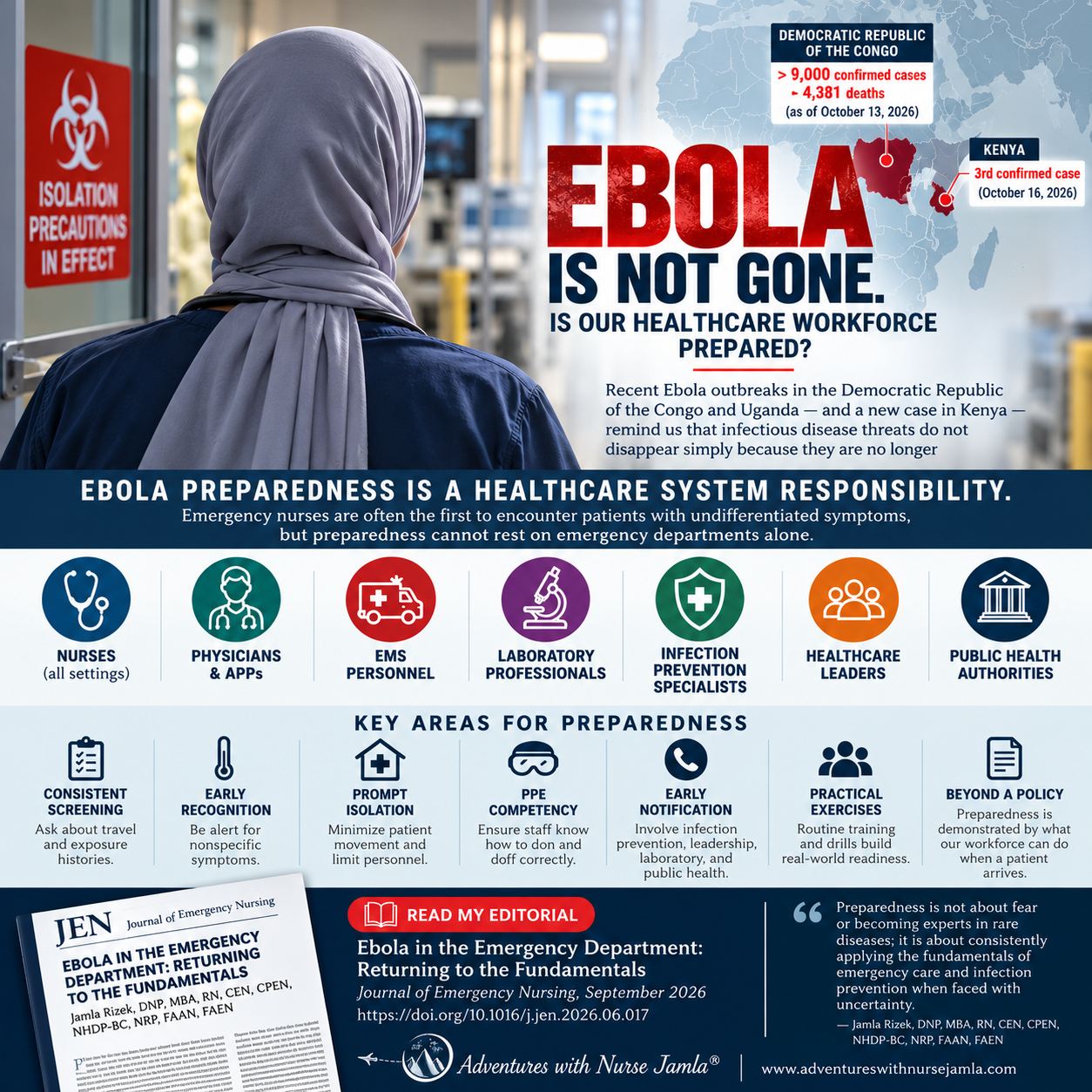

The recent Ebola outbreaks in the Democratic Republic of the Congo and Uganda are important reminders that emerging infectious disease threats do not disappear simply because they are no longer making headlines.
In my recently published editorial in the Journal of Emergency Nursing, “Ebola in the Emergency Department: Returning to the Fundamentals,” I discuss the importance of maintaining preparedness for Ebola and other high-consequence infectious diseases.
While emergency nurses are often the first healthcare professionals to encounter patients with undifferentiated symptoms, preparedness cannot be the responsibility of emergency departments alone.
Every healthcare professional has a role to play. Nurses, physicians, advanced practice providers, EMS personnel, laboratory professionals, infection prevention specialists, public health professionals, and healthcare leaders must understand their responsibilities in recognizing and responding to potential infectious disease threats.
But I want us to think beyond simply having policies and procedures in place.
Are we actually prepared?
🔹 Are we consistently obtaining relevant travel and exposure histories?
🔹 Do our healthcare professionals recognize the early signs and symptoms of Ebola and other high-consequence infectious diseases?
🔹 Do staff know how to identify, isolate, and notify the appropriate personnel when a potentially infectious patient presents?
🔹 Is appropriate personal protective equipment (PPE) accessible, and are healthcare professionals competent in donning and doffing it safely?
🔹 When was the last time your healthcare organization conducted a practical infectious disease preparedness exercise?
🔹 Are our healthcare systems prepared to coordinate patient care, laboratory testing, infection prevention, and public health notification?
Having PPE does not mean staff are competent in using it. Having a policy does not mean an organization is operationally prepared. And completing an annual training module does not necessarily translate into the ability to respond effectively.
We have learned difficult lessons from previous Ebola outbreaks and the COVID-19 pandemic. Yet, too often, preparedness becomes a priority only when an outbreak captures public attention.
We cannot continue this cycle.
Preparedness requires more than awareness. It requires continuous education, hands-on training, realistic exercises, interdisciplinary coordination, and leadership accountability, and this extends beyond Ebola. The same foundational practices that allow us to recognize and safely manage a patient with suspected Ebola are essential when responding to other emerging and reemerging infectious diseases.
The risk to the general U.S. public may remain low, but that should never be an excuse for complacency.
I encourage healthcare professionals and organizational leaders to take a moment to evaluate their readiness. Not just what is written in their policies, but what their workforce can actually do when a patient arrives.
Preparedness is not something we begin when an outbreak reaches our doorstep. It is something we build, practice, and sustain every day.
📖 Read my editorial:
Ebola in the Emergency Department: Returning to the Fundamentals
Journal of Emergency Nursing, September 2026
https://doi.org/10.1016/j.jen.2026.06.017
🌐 Adventures with Nurse Jamla®
www.adventureswithnursejamla.com
My question to healthcare professionals and leaders: When was the last time your organization actually tested its readiness to manage a patient with a high-consequence infectious disease?
#Ebola #InfectiousDiseasePreparedness #EmergencyNursing #DisasterNursing #DisasterPreparedness #HealthcareLeadership #InfectionPrevention #PublicHealth #HealthcareWorkerSafety #NursingEducation #GlobalHealth