

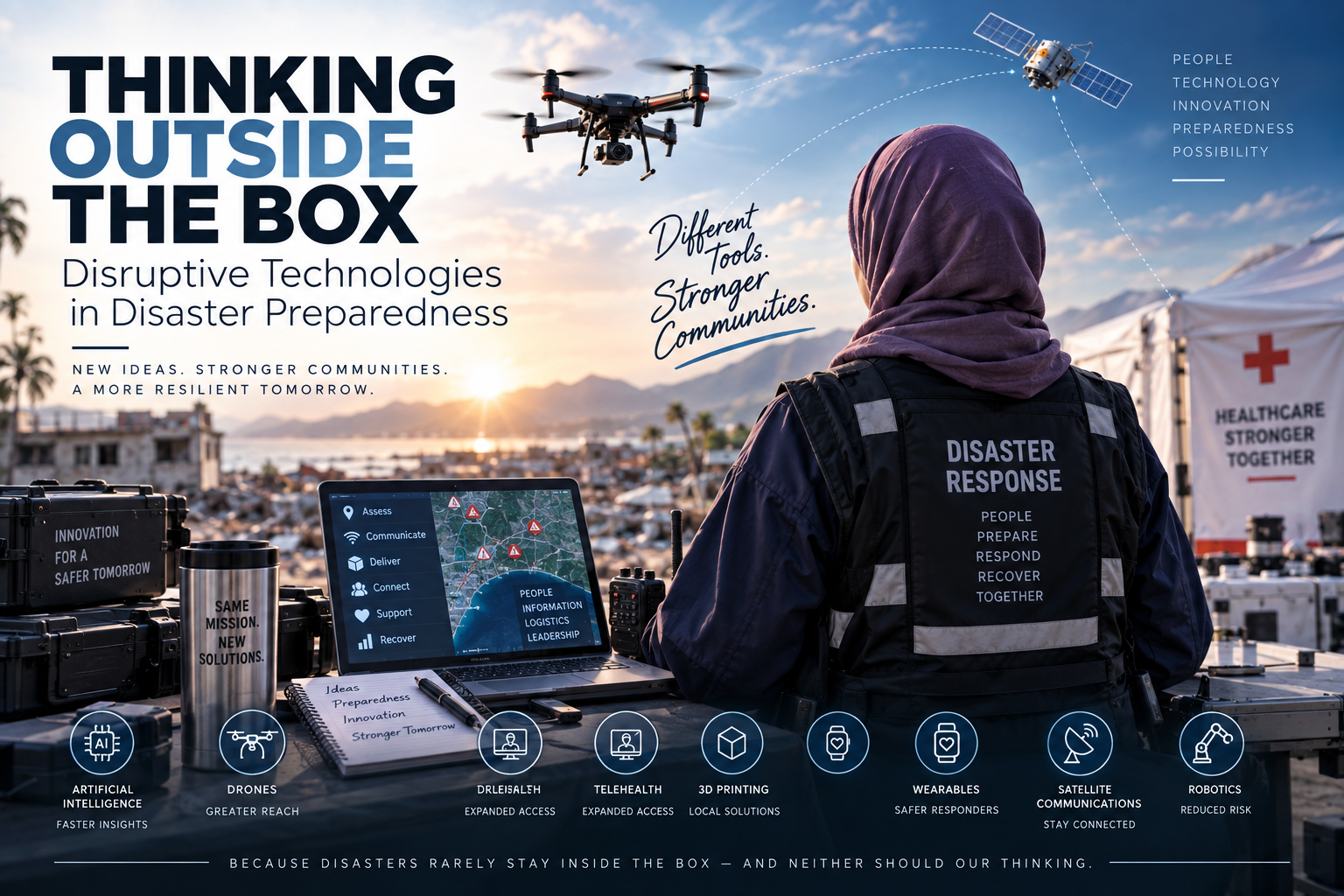

When we talk about disaster preparedness, we often talk about the things we already know: communication systems, generators, emergency operations plans, personal protective equipment, staffing, supplies, and evacuation.
But disasters have a way of making the things we depend on suddenly unavailable.
That is why preparedness also requires us to think outside the box.
Disruptive technologies are changing how we prepare for, respond to, and recover from disasters. Artificial intelligence, drones, telehealth, robotics, wearable technology, satellite communications, 3D printing, autonomous systems, and other emerging tools are creating possibilities that would have sounded unrealistic not that long ago.
The question is no longer simply, What technology do we have?
The better question is: What problem are we trying to solve?
A drone, for example, is not just something that takes pictures from the sky. In a disaster, it may help assess damage when roads are inaccessible, identify isolated communities, deliver medications or supplies, or give responders information before they enter a dangerous environment.
Telehealth is not simply a convenient way to see a provider from home. In a disaster, it can extend scarce clinical expertise into shelters, alternate care sites, rural communities, or areas where specialists cannot physically reach patients.
3D printing may allow critical components or medical supplies to be produced closer to where they are needed when traditional supply chains are disrupted.
Wearable technology may help monitor responders working in extreme heat or other hazardous environments.
Artificial intelligence may help analyze large amounts of information, identify patterns, support situational awareness, translate information, or assist with resource planning.
And sometimes the most disruptive technology is not the most sophisticated one. A satellite phone, portable solar charger, offline mapping system, or simple low-bandwidth communication platform may be far more valuable than an advanced system that requires infrastructure we no longer have.
Technology Is Not Preparedness
This is where I think we have to be careful.
Buying technology does not make an organization prepared.
If your staff have never used it, if it has not been exercised, if nobody knows who is responsible for it, if it cannot function when the internet goes down, or if it cannot integrate into your existing operations, then it may become one more piece of equipment sitting in a box during the disaster.
Available does not mean accessible. Accessible does not mean familiar. And familiar does not mean competent.
Emerging technology has to be incorporated into training, exercises, policies, hazard vulnerability analyses, continuity planning, and everyday operations long before we expect people to depend on it during a crisis.
We also have to ask harder questions.
What happens when the technology fails?
Who verifies the information it provides?
What happens to patient privacy?
Could the technology unintentionally exclude older adults, people with disabilities, people with limited digital access, or communities that speak different languages?
Are we creating a new capability, or a new dependency?
And perhaps most importantly: Do we still know how to operate without it?
Start With the Problem, Not the Product
I think one of the biggest opportunities for healthcare