

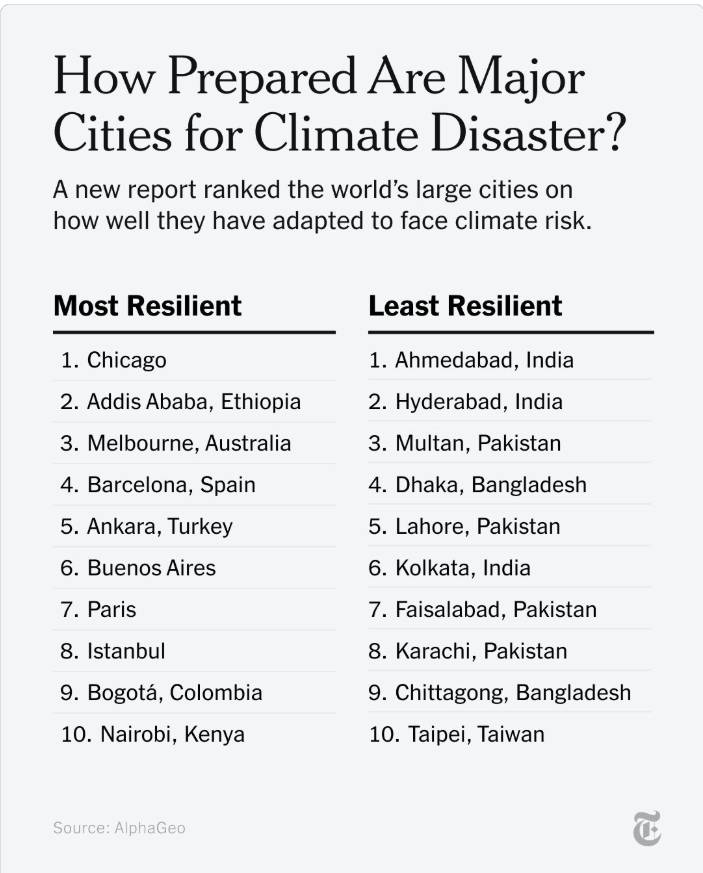

I came across a graphic today asking a simple question: How prepared are major cities for climate disaster?
Read the New York Times article
Read the full AlphaGeo report and methodology
The answer was more interesting to me than the rankings themselves.
A new analysis of 72 of the world’s largest cities looked at their exposure to climate-related hazards, including flooding, extreme heat, drought, wildfire, and hurricane winds, but it didn’t stop there. Researchers also examined what those cities had done to adapt: early-warning systems, infrastructure, governance, policy, flood protection, drainage systems, and other measures designed to reduce the consequences when hazards occur.
Chicago ranked first. Ahmedabad, India, ranked at the other end of the spectrum. Several South Asian cities were among those with the greatest remaining risk, but I don’t think the most important takeaway is which city finished first or last.
The important takeaway is that risk and disaster are not the same thing.
This is something we talk about constantly in disaster preparedness.
A hurricane is a hazard.
Extreme heat is a hazard.
Flooding is a hazard.
Whether that hazard becomes a catastrophe depends, in large part, on what was in place before it happened.
Did people receive the warning?
Could they understand it?
Could they act on it?
Were hospitals prepared for the surge?
Was the electrical grid capable of remaining operational?
Were medications, oxygen, transportation, food, water, and communications available?
Could people with disabilities evacuate?
Could an older adult living alone get to a cooling center?
Could someone who depends on electrically powered medical equipment survive a prolonged outage?
Could healthcare workers get to work, and could the healthcare system sustain operations after the first 24 or 48 hours?
Those questions are where climate resilience becomes disaster preparedness.
One of the findings from the AlphaGeo analysis that stood out to me was that geography alone did not determine resilience. Cities with similar physical risks could have substantially different remaining risk depending on adaptation. The report describes this difference as the “adaptation delta.”
That matters.
Because we cannot prevent every heat wave, flood, wildfire, drought, or severe storm.
But we can influence what happens next.
And that is what preparedness is supposed to do.
Too often, we measure preparedness by whether an organization has an emergency operations plan sitting somewhere on a shared drive, whether staff completed an annual module, or whether we checked the box on an exercise.
That is not resilience.
Resilience is whether the system still works when the assumptions behind the plan no longer do.
It is whether the hospital can continue caring for patients when the power is unstable, the roads are flooded, staff cannot get to work, supply deliveries are delayed, communications are disrupted, and the emergency department is simultaneously receiving patients affected by the disaster.
It is also why healthcare has to be part of climate adaptation discussions.
Extreme heat means heat illness, cardiovascular and respiratory complications, medication-related risks, occupational exposures, and increased demand on emergency services. Flooding means injuries, displacement, contaminated water, interrupted healthcare access, infectious disease concerns, and disrupted supply chains. Wildfires bring burns, respiratory illness, evacuations, power interruptions, and healthcare facility threats.
Climate adaptation is therefore not only an environmental issue.
It is a public health issue. It is a healthcare preparedness issue. And increasingly, it is a disaster medicine and disaster nursing issue.
There is another piece of this conversation that we cannot ignore.
A city can rank as “resilient” overall while individual communities within that city remain extraordinarily vulnerable. AlphaGeo itself cautions that its scores are city-level averages and that risk can vary significantly from one neighborhood, or even one street, to another.
That may be the most important caveat in the entire report.
Because disasters are never experienced equally.
The person with financial resources, transportation, stable housing, insurance, air conditioning, backup power, and the ability to leave is experiencing a very different disaster than the person without those things.
That is why preparedness cannot simply ask, “Is our city ready?”
We also have to ask:
Ready for whom?
The real measure of resilience is not how quickly the strongest parts of a community recover. It is whether the systems we build before a disaster protect the people who will have the hardest time protecting themselves when one occurs.
The rankings are interesting.
The preparedness gap is much more important.
And for those of us working in emergency nursing, disaster nursing, public health, emergency management, and healthcare preparedness, that gap is where our work begins.