

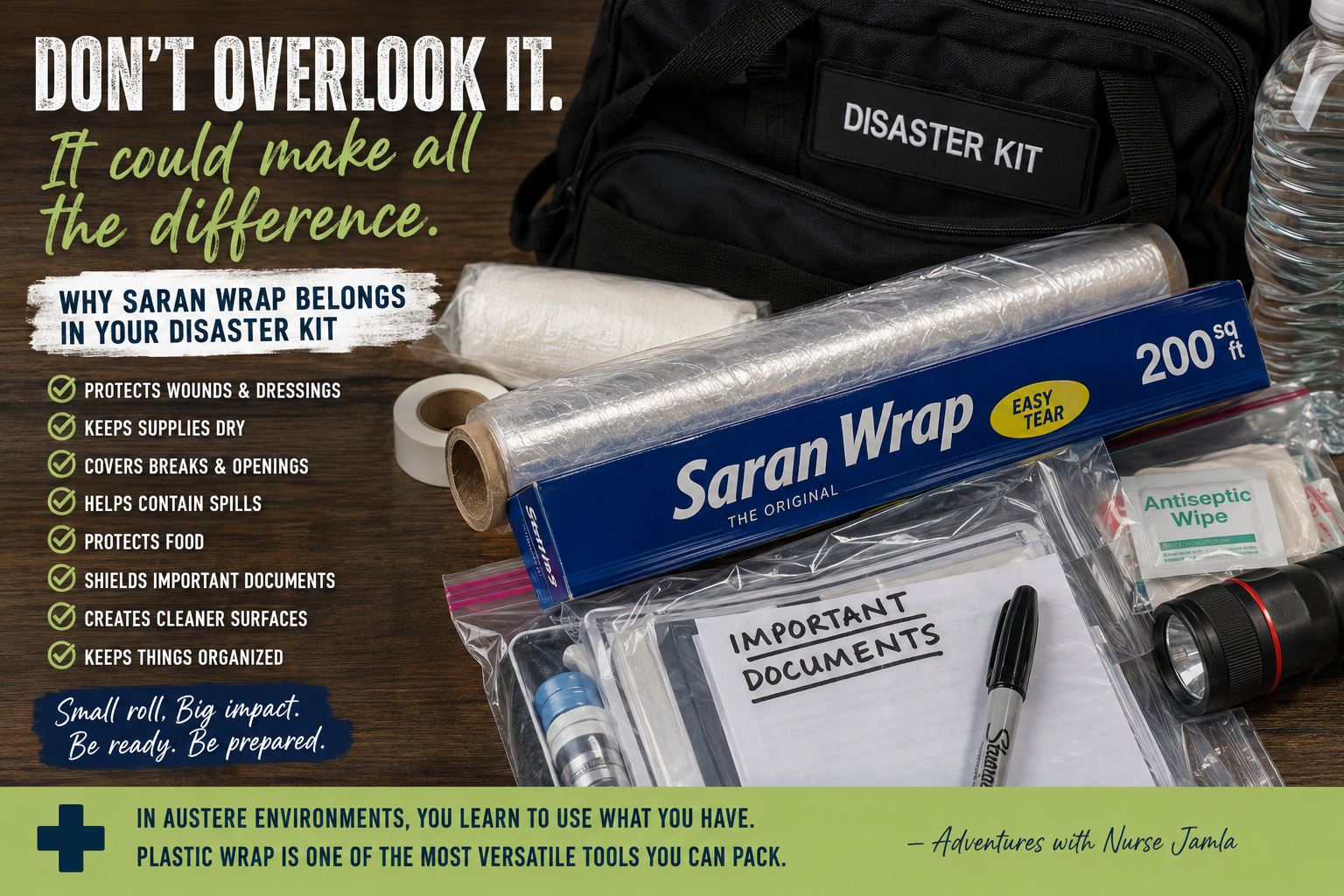

When we talk about disaster preparedness, everyone thinks about the obvious things: water, flashlights, batteries, medications, first aid supplies, and food.
But there is one inexpensive item I think deserves a place in almost every disaster kit:
Plastic wrap. Yes, Saran Wrap.
I have spent a lot of my career working in emergency medicine, disaster response, and austere environments, and one thing those environments teach you very quickly is this:
You learn to use what you have.
In a hospital, we are accustomed to opening a supply cabinet and having exactly what we need. In an austere environment, that cabinet may not exist. The ambulance may be hours away. The supply truck may not be coming. You may be caring for patients in a shelter, field hospital, damaged building, temporary clinic, evacuation site, or somewhere that was never intended to deliver healthcare.
That changes how you think about supplies.
Plastic wrap weighs almost nothing, takes up very little space, and can serve multiple purposes for both everyday disaster preparedness and patient care when resources are limited.
1. Protect Wounds and Dressings
Imagine you’ve cleaned and dressed a wound, but now you need to keep that dressing dry.
Maybe you’re dealing with flooding. Maybe it’s pouring rain. Maybe you’re transporting a patient through a wet environment. Maybe you’re working somewhere where your supply of clean dressings is limited and you cannot simply replace one every time it gets wet.
Plastic wrap can provide a temporary water-resistant outer covering over an existing dressing.
That distinction matters.
I am not suggesting packing household plastic wrap directly into an open wound or treating it as sterile wound-care material. It isn’t. But protecting the dressing you already applied can be extremely valuable when your resources are limited.
2. Protect Burns During Initial Care and Transport
Burn patients can be particularly challenging in austere environments.
Once a burn has been appropriately cooled when indicated, the goal becomes protecting the injured area while preventing contamination and unnecessary manipulation during transport.
Plastic film has been used in burn care as a temporary covering in appropriate circumstances because it can provide a barrier without adhering like some materials can.
But this is an area where technique matters. Burns still require proper assessment and treatment, and circumferential wrapping can become dangerous as swelling develops.
For the average disaster kit, think of plastic wrap as a potential temporary protective covering, not definitive burn treatment.
3. Protect IV Sites, Dressings, and Medical Equipment
Now imagine you’re moving a patient during heavy rain.
They have an IV. Maybe they have a wound dressing. Maybe you’re carrying monitoring equipment or other supplies that weren’t designed to be exposed to the elements.
In an ambulance or hospital, we often take environmental protection for granted.
In austere medicine, you don’t get that luxury.
Plastic wrap can sometimes provide an additional temporary barrier around already secured dressings or equipment during movement through wet or dirty environments.
Again, it shouldn’t be wrapped tightly around an extremity, and it doesn’t replace proper medical equipment. The goal is protection, not compression.
4. Protect Medical Supplies from the Environment
This may be one of its most valuable uses.
Think about what happens when healthcare moves outside of the hospital.
Suddenly you are dealing with:
- Rain
- Mud
- Dust
- Sand
- Floodwater
- Wind
- Damaged buildings
- Limited clean surfaces
- Large numbers of people moving through your treatment area
Gauze, dressings, medications, batteries, paperwork, and other supplies suddenly become vulnerable.
A few layers of plastic wrap around a supply bundle can provide another barrier while you’re transporting or storing equipment.
Is it equivalent to a waterproof medical container? Of course not.
But austere medicine isn’t always about having the ideal solution.
Sometimes it is about protecting the resources you have long enough to use them.
5. Create a Cleaner Temporary Work Surface
This is one people don’t always think about.
Imagine trying to provide patient care in a shelter after a hurricane.
Your “treatment area” might be a folding table.
Or a school desk.
Or a countertop.
Or the hood of a vehicle.
Or whatever flat surface you can find.
Covering a surface with plastic wrap can create a disposable physical barrier before organizing medications, dressings, or other supplies.
Notice that I said cleaner, not sterile.
Plastic wrap doesn’t magically sterilize a contaminated table. But in an austere environment, creating layers and barriers between your equipment and the environment can help you manage limited resources.
6. Separate Clean and Dirty Equipment
In disaster medicine, controlling contamination can become incredibly difficult.
You may be working with limited space and trying to establish areas for clean supplies, dirty equipment, patient belongings, waste, and medical care, all within the same room.
Plastic wrap can help bundle or temporarily isolate certain items until they can be appropriately cleaned, disinfected, or disposed of.
It can also help visually organize supplies.
This is particularly useful when you have multiple responders working in a temporary treatment area and everyone needs to understand what is clean, what has been used, and what shouldn’t be touched.
7. Help Protect Patients During Movement
Patient movement in austere environments isn’t always from a hospital bed to a stretcher.
Sometimes you’re moving someone through rain, snow, debris, mud, or damaged infrastructure.
A patient may need to wait outside for transportation. An evacuation vehicle may not be completely protected from the weather. Supplies attached to the patient may need additional protection.
Plastic wrap can provide an additional external barrier for selected equipment or already-dressed areas while the patient is being moved.
But never compromise circulation, breathing, temperature regulation, or your ability to reassess the patient just to keep something dry.
Patient care always comes first.
8. Protect Medications and Patient Records
During disasters, we sometimes focus so heavily on medical equipment that we forget about something equally important:
Information.
Patient tracking sheets, medication lists, triage tags, identification information, transfer paperwork, and handwritten clinical notes may be the only documentation traveling with a patient.
Now imagine standing outside in the rain waiting for an evacuation vehicle.
That piece of paper matters.
Plastic wrap can provide an additional layer of protection around documents, medication containers, and other items that need to remain dry during transport.
9. Temporarily Cover Broken Windows or Openings
After a hurricane, tornado, explosion, or severe storm, broken windows can expose the inside of a building to rain, wind, dust, insects, and debris.
Plastic wrap isn’t going to replace plywood or proper repairs, but it may help temporarily cover smaller openings or reinforce another temporary covering.
In a healthcare setting, this becomes even more important if you’re trying to maintain a relatively protected area for patient care or supply storage inside a damaged structure.
10. Protect Food and Water-Related Supplies
This is probably the use everyone already knows.
During a power outage or evacuation, plastic wrap can cover food containers, protect items from insects and debris, and help separate portions.
It can also protect utensils and other food-preparation items until they’re needed.
But remember: plastic wrap does not make unsafe food safe.
If refrigerated food has remained at an unsafe temperature too long, covering it doesn’t change that.
11. Bundle and Organize Supplies
In austere environments, organization becomes a patient-safety issue.
If you’re digging through three bags looking for gauze while someone is bleeding, your system isn’t working.
Plastic wrap can bundle supplies together, for example, creating small groups of wound-care supplies, hygiene items, or other frequently used materials.
You can also see through it.
That sounds insignificant until you’re trying to find something quickly in poor lighting while wearing gloves and managing multiple patients.
The Bigger Lesson: Austere Medicine Changes How You Think
This is really why I tell people to put things like plastic wrap in their disaster kits.
It isn’t because Saran Wrap is some magical piece of emergency medical equipment.
It isn’t.
It is because disasters change the environment in which we provide care.
You may have fewer supplies.
You may have fewer people.
You may have limited electricity.
You may not have running water.
You may not have reliable transportation.
You may have more patients than you have resources.
And you may have to care for someone much longer than you ever anticipated.
That’s prolonged casualty care.
That’s austere medicine.
That’s disaster response.
And when those things happen, your mindset has to change from:
“Where is the piece of equipment designed specifically for this problem?”
to:
“What do I have, what does this patient need, and how can I safely bridge the gap until I have something better?”
That last word is important: safely.
Improvisation doesn’t mean anything goes.
What Plastic Wrap Should NOT Be Used For
Don’t use household plastic wrap as a substitute for professional medical treatment. Don’t pack it into open wounds. Don’t wrap it tightly around an injured extremity where it could compromise circulation. Don’t cover someone’s face or interfere with their breathing. Don’t use it in a way that prevents you from reassessing your patient. And don’t assume that because something is covered in plastic, it is sterile or decontaminated.
There are specialized medical products and techniques that may look similar to something you could improvise with plastic wrap. That doesn’t make household plastic wrap an equivalent replacement.
Improvisation should solve a problem without creating a bigger one.
My Disaster-Kit Rule: Pack Things That Can Do More Than One Job
Space matters.
Weight matters.
And in a real disaster, versatility matters.
That’s why I love inexpensive supplies that can solve multiple problems.
A roll of plastic wrap can help protect dressings, shield supplies from the environment, protect paperwork, organize equipment, create temporary barriers, cover food, and solve dozens of little problems you probably won’t anticipate until you’re standing in the middle of a disaster.
After years of emergency medicine and disaster response, that’s one of the biggest lessons I continue to carry with me:
You cannot pack for every possible scenario.
You pack the basics.
You understand what those supplies can, and cannot, do.
You learn to improvise.
And you continuously ask yourself:
What does my patient need right now, and how do I safely provide it with the resources I have?
So when you’re updating your disaster kit, grab an extra roll of plastic wrap.
It’s cheap.
It’s lightweight.
It’s versatile.
And when resources become limited, sometimes the simplest things in your kit become surprisingly valuable.
Shoutout to my colleague, Travis Kaufman for reminding of the use of saran wrap. 
Preparedness isn’t about having everything. It’s about knowing how to make the most of what you have.
— Adventures with Nurse Jamla